Technique 12 Oct 2026
How to back squat: technique step by step
Thanos Mpizpos
Strength and conditioning coach
5 min read
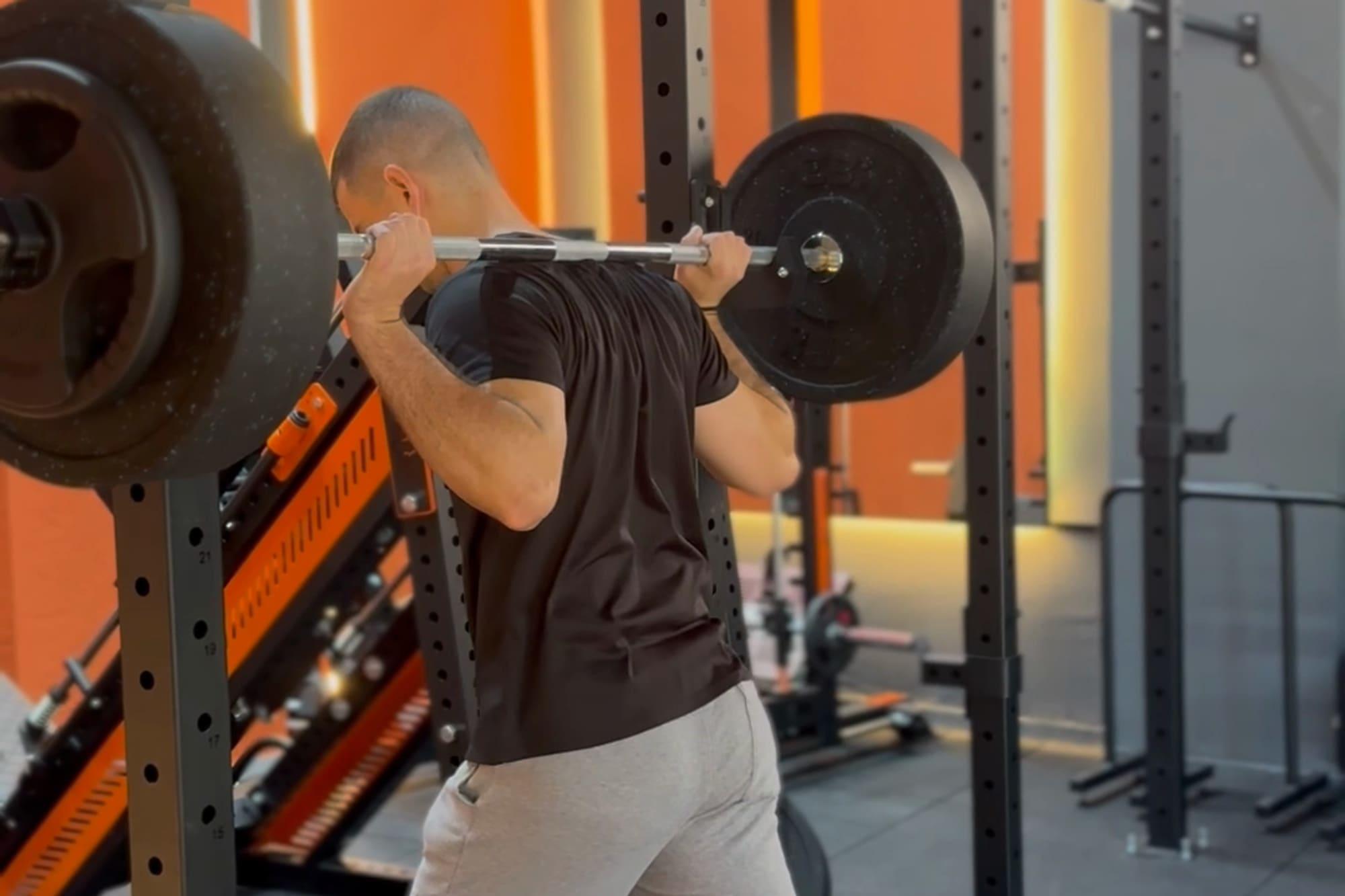
The back squat builds the legs and hips like few other exercises. How to set up, go down and stand up with good technique, and the mistakes to watch for.
Set up the bar
Set the bar in the rack at about the height of your armpits. Set the safety bars just below the bottom of your squat, so you can leave the weight on them if you get stuck. Step under the bar and rest it across your upper back, on the muscle just below your neck and not on the neck itself. Grip it a little wider than your shoulders and squeeze your shoulder blades together, so the bar sits on a solid shelf.
Unrack it and find your stance
Stand up to lift the bar off the hooks and take two or three short steps back. Don't walk it further than you need to.
- Feet about shoulder-width apart
- Toes turned out slightly, 15 to 30 degrees
- Weight spread over the whole foot
- Eyes forward, on a fixed point
Brace before you go down
Take a big breath into your belly and tighten your core as if someone were about to push you. Hold that pressure for the whole rep. It keeps your back in position under the bar.
Sit down between your heels
Bend at the hips and knees at the same time and lower yourself under control, without dropping. Let your knees travel forward and out in line with your toes, and keep your chest facing forward. Go as deep as you can while your back stays neutral and your heels stay down. For most people that means the thighs reach at least parallel to the floor.
Drive back up
Push the floor away through the whole foot and stand up, with your hips and chest rising together. Don't bounce out of the bottom. Breathe out at the top, take a new breath and brace again before the next rep.
Muscles worked
In a squat your hips, knees and ankles all bend together, so a lot of muscles work at once. The quads and glutes take most of the load.
- Quadriceps: straighten the knee and do most of the work
- Gluteus maximus: extends the hip, and works harder the deeper you go
- Adductors, on the inside of the thigh: help the glutes on the way up
- Hamstrings and calves: steady the knees and ankles
- Lower back and abs: hold your trunk in place
Why squat
You'll find it in almost every strength programme. One exercise trains a large part of your body, and you add weight in small steps.
- Builds the legs, glutes and trunk together
- Trains an everyday movement: sitting down and standing up
- In athletes, squat strength is linked to higher jumps and faster sprints
- Lifting weights, with exercises like the squat, can also help bone density
Common mistakes
Most of these are easier to spot on video. Ask someone to film you from the side and from the front.
- Knees caving in on the way up. Think about spreading the floor apart with your feet.
- Heels lifting off the floor. Keep your weight over the whole foot, or try a slightly wider stance.
- Hips rising faster than the chest. This shifts the load onto your lower back. Take a little weight off and lift your chest and hips together.
- Losing the brace halfway through the set. Take a fresh breath and brace before every rep.
- Adding weight before the technique is consistent. If you can no longer reach the same depth, the weight is too heavy.
How to fit it into your training
Learn the movement with an empty bar or a light load. Squat early in the session, after two or three light warm-up sets. When you can do one or two reps more than your target with good form, add 2.5 to 5 kg. If you're not sure how your squat looks, ask one of our coaches to watch a set.
- If you're new: twice a week, 3 sets of 8 to 12 reps, finishing each set with 2 or 3 reps still in the tank
- Experienced, for strength: 3 to 5 sets of 3 to 6 reps with a heavier load and 3 to 5 minutes' rest
- Experienced, for muscle: 3 or 4 sets of 6 to 12 reps with 2 to 3 minutes' rest
How deep should I squat?
As deep as you can with your back neutral and your heels on the floor. For most people that's at least thighs parallel to the floor, and lower if you can keep good form. In one ten-week study, full squats grew the glutes and adductors more than half squats. A review of the research found no evidence that deep squats with good technique are riskier for healthy knees.
Is it bad if my knees go past my toes?
Not on its own. In a back squat it's normal for your knees to travel a little past your toes. If you force them to stay back, your chest tips further forward and more of the load goes to your hips and lower back. What matters is that your knees follow the line of your toes and your heels stay down.
What if my back or knee hurts when I squat?
Stop the set. Tired, burning muscles are normal; sharp pain in a joint or your lower back is not. Don't train through pain. If it stays or keeps coming back, see a physiotherapist or doctor.
Want someone to check your technique? See group personal training
Share or follow: Instagram