Technique 8 Nov 2026
How to deadlift with good technique

Thanasis Aggelidis
Physical education coach
5 min read
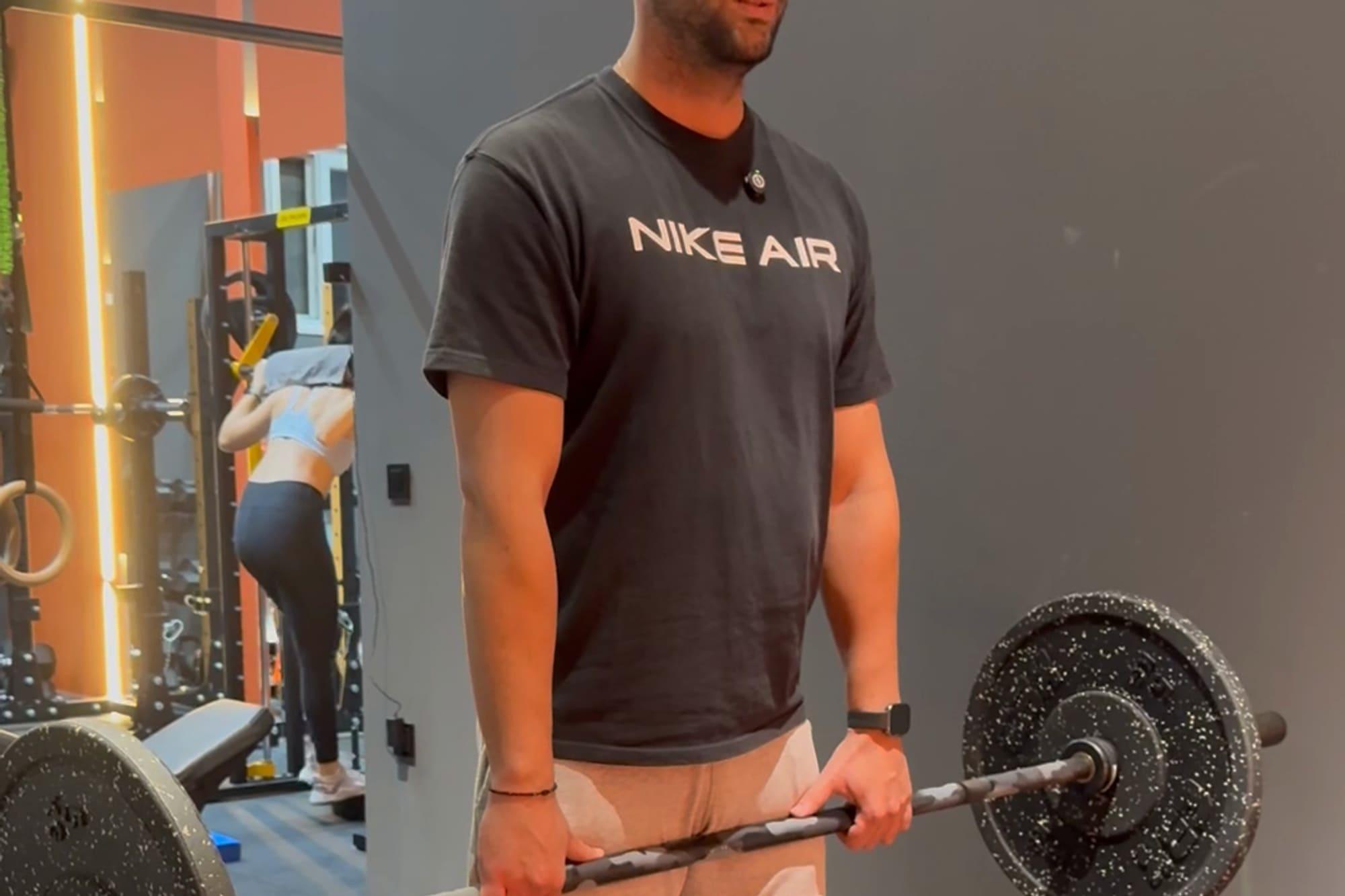
The deadlift works the hamstrings, glutes and back together. Set up the same way every time and it's one of the most reliable ways to get strong.
Set your feet
Stand with your feet about hip-width apart and the bar over the middle of your feet, a couple of centimetres from your shins. Point your toes forward or slightly out. From above, the bar should cut your foot in half.
Grip the bar
Push your hips back and bend your knees until you can reach the bar. Grip it just outside your legs, with both palms facing you. For heavy sets you can switch to a mixed grip, one palm facing you and one facing away, or use straps. If you use a mixed grip, swap which hand faces away from set to set.
Get tight before you pull
Bring your shins to the bar, lift your chest and keep your back flat from head to hips. Look at a spot on the floor a little in front of you so your neck stays in line with your back. Keep your arms straight, like hooks. Pull the slack out of the bar until you feel it pressing up against your hands, then take a breath into your belly and brace your core.
Push the floor away
Drive through your feet and let your hips and shoulders rise together. Keep the bar against your legs all the way up and your core tight until the top. Finish standing tall with your hips through, without leaning back. Breathe out there.
Lower it under control
Push your hips back first and let the bar slide down your thighs. Once it passes your knees, bend them and set it down in the same place you lifted it from. Before the next rep, reset your position, take a fresh breath and brace again.
Muscles worked
The deadlift is a whole-body lift that leans on the back of your body. EMG studies show that in the conventional deadlift the muscles along your spine and your quads work hard, alongside the glutes and hamstrings.
- Glutes and adductors: extend your hips and stand you up
- Hamstrings: help the glutes extend the hips
- Quads: straighten your knees, mostly as the bar leaves the floor
- Spinal erectors: keep your back flat
- Lats and traps: keep the bar close to your body and your shoulders in place
- Abs: brace your trunk
- Forearms: hold your grip
What the deadlift does for you
It's one of the few lifts where you move a lot of weight with your whole body at once. That makes it a good base for strength.
- Strengthens your glutes, hamstrings and back in one lift
- Teaches you to bend from the hips (the hip hinge), the same move you use to pick something heavy up off the floor
- Builds your grip
- Like any weight training, it's good for your bones
- Your progress is easy to see in the weight on the bar
Common mistakes
Most of them come from rushing the setup. If you're not sure, ask someone to film you from the side.
- Rounding the lower back
- Letting the bar drift away from the legs
- Jerking the bar off the floor
- Hips rising first, so the legs straighten before the bar moves
- Sitting down too low, as if it were a squat
- Pulling with bent arms
- Leaning back at the top
How to fit it into your training
Deadlift early in your session while you're fresh, after two or three lighter warm-up sets. Once or twice a week is enough for most people. End each set before your form breaks down. You don't need to go to failure.
- If you're new: 2 to 3 sets of 5 to 8 reps with a weight you could lift a few more times. Add a little weight each week as long as your form stays the same
- If you're experienced and training for strength: 3 to 5 sets of 3 to 6 reps, resting 2 to 5 minutes between sets
- If you're training for muscle: 3 to 4 sets of 6 to 10 reps
My lower back hurts when I deadlift. What am I doing wrong?
Usually your lower back is rounding, the bar is drifting away from your legs, or you're leaning back at the top. Drop the weight, film a set from the side and ask one of our coaches to watch you. Some tiredness in your lower back muscles the next day is normal. But if you feel sharp pain, pain that runs down your leg, numbness, or pain that doesn't ease within a few days, stop deadlifting and see a physiotherapist or doctor.
Do I need a belt to deadlift?
Not to learn the lift. Learn to brace your core without one first. A belt helps on very heavy sets, close to the most you can lift, because it gives your belly something to push against when you breathe in and brace. It won't fix poor technique.
What's the difference between a deadlift and a Romanian deadlift?
In a conventional deadlift the bar starts on the floor and your knees bend quite a lot. In a Romanian deadlift you start standing with the bar in your hands, keep a slight bend in your knees and lower the bar only as far as your back stays flat, usually just below the knees. It works your hamstrings more and your quads less, and it's a good way to learn the hip hinge.
Want someone to check your technique? See group personal training
Share or follow: Instagram